Your Pre-Starts Are Broken. Here's How to Know (And Fix It)
When researchers ask workers to describe pre-starts in one word, the most common answer is "boring." The Fair Work Commission has explicitly criticised "tick and flick" meetings that demonstrate compliance without achieving it. Here's how to tell if your pre-starts are working – and what to do if they're not.
The one-word test
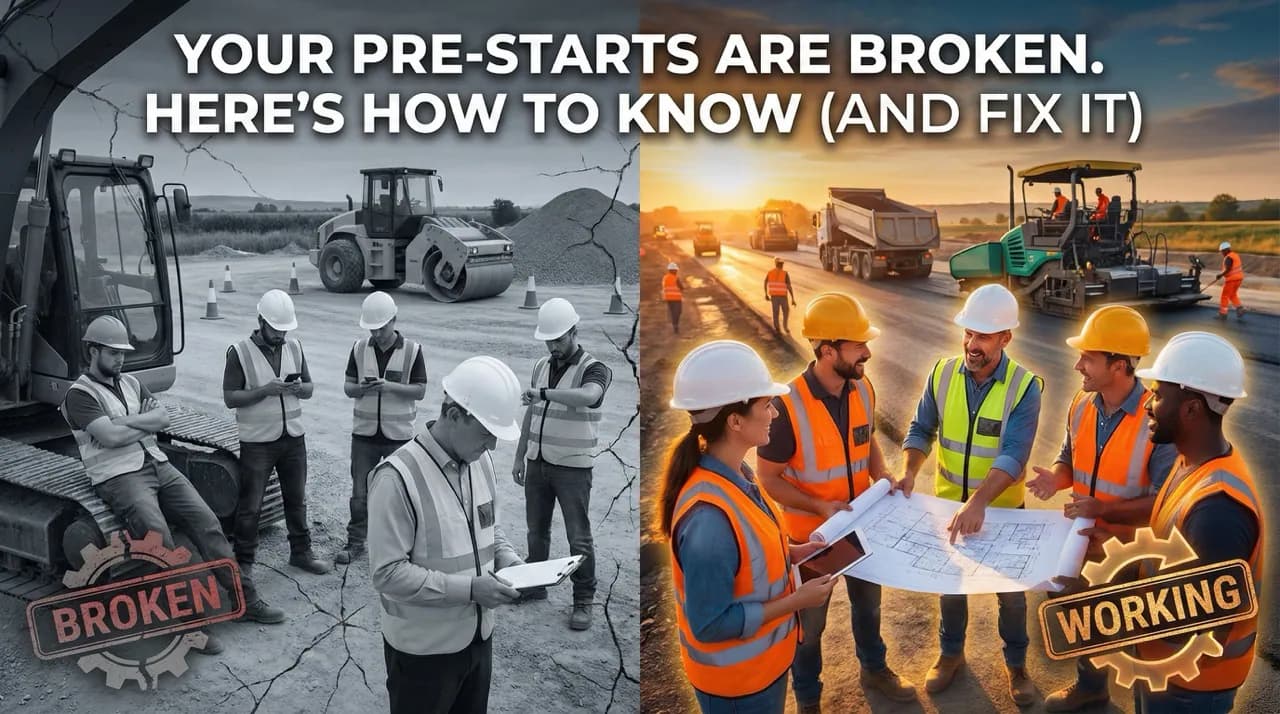
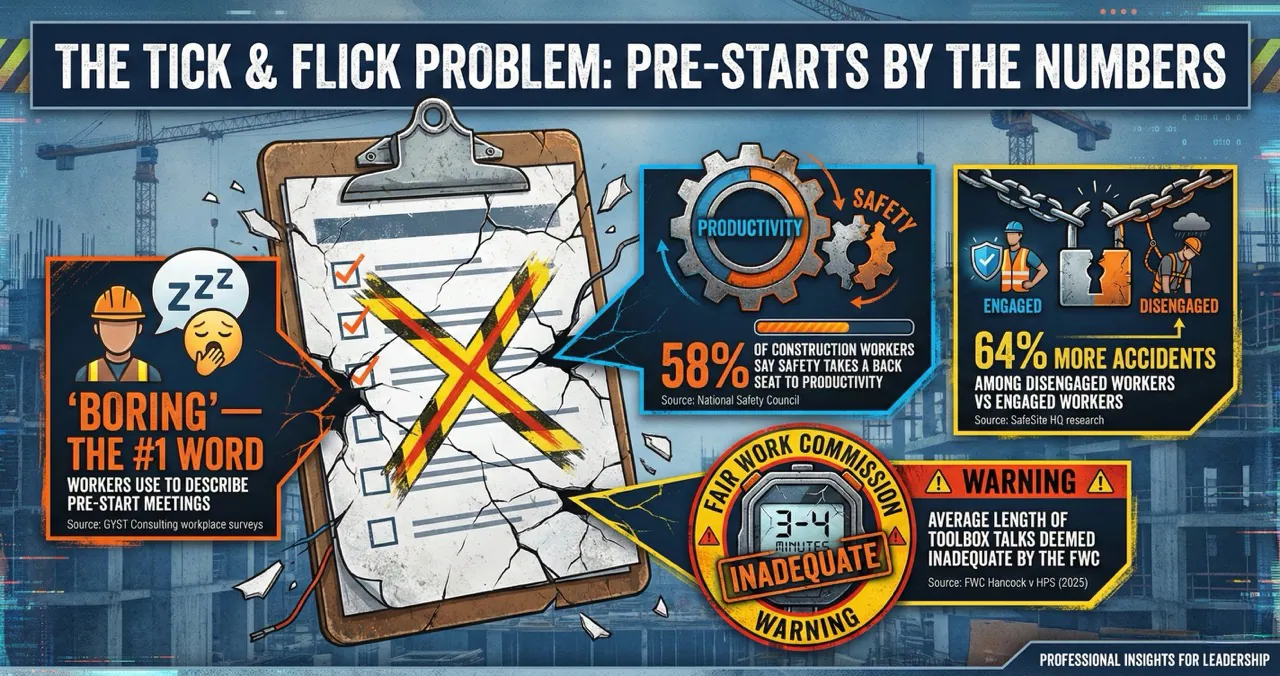
When workplace psychologist Dr. Lloyd from GYST Consulting asks construction workers to describe pre-start meetings in a single word, the most common response is consistent across companies: "boring."
This isn't isolated feedback from a few disgruntled workers. It's the norm across mining, oil and gas, and construction sectors. And it points to a systemic problem that's now attracting serious regulatory attention.
The Fair Work Commission has noticed
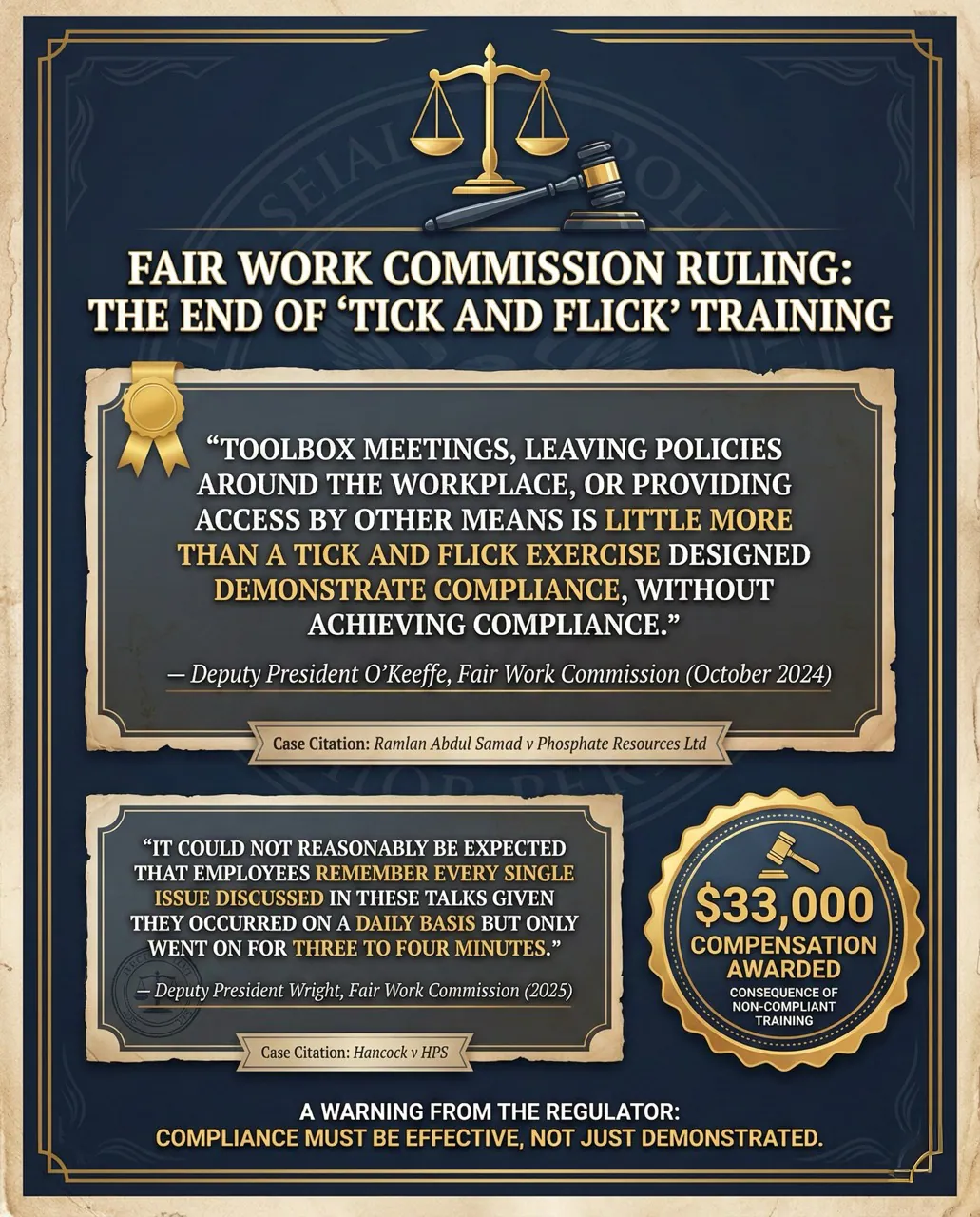
In October 2024, Fair Work Commission Deputy President O'Keeffe delivered a landmark ruling that should concern every safety manager in Australia. He stated that toolbox meetings, policies left around the workplace, and email notifications constitute "little more than a tick and flick exercise designed to demonstrate compliance, without achieving compliance."
The case – Ramlan Abdul Samad v Phosphate Resources Ltd – resulted in a $33,000 compensation award despite valid reasons for termination existing. The message was clear: superficial safety communication creates legal liability, not protection.
O'Keeffe set a high bar for what constitutes proper training: "not through a tick-and-flick exercise but through a culturally and linguistically appropriate interactive training course that dealt with not just the 'what' but also the 'why'" of workplace policies.
In another case, Hancock v HPS (2025), Deputy President Wright found that brief toolbox talks were inadequate because "it could not reasonably be expected that employees remember every single issue discussed in these talks given they occurred on a daily basis but only went on for three to four minutes."
The regulatory position is now unambiguous: if your pre-starts are compliance theatre, you're exposed.
The visibility gap most organisations can't answer
Here's a question that makes safety managers uncomfortable: Which business units are actually doing quality pre-starts?
Not which ones are completing the paperwork. Which ones are having genuine conversations about today's actual risks?
Most organisations can report completion rates. Few can report quality. And without that visibility, you're flying blind.
A Safe Work Australia survey found that while 90% of employers believed there was good communication in their workplace about safety issues, workers had notably lower levels of agreement. Perhaps more telling: only 4 in 10 employers indicated their workplace even reviewed incident reports and statistics – suggesting superficial engagement extends beyond toolbox talks to safety management generally.
The numbers that should worry you
The data on worker engagement in safety communications reveals the scale of the problem:
58% of American construction workers say safety takes a back seat to productivity and completing job tasks (National Safety Council survey). While this is US data, Australian conditions are comparable.
48% believe safety meetings are held less often than they should be.
67% feel performance standards are higher for job tasks than for safety.
47% say employees are afraid to report safety issues.
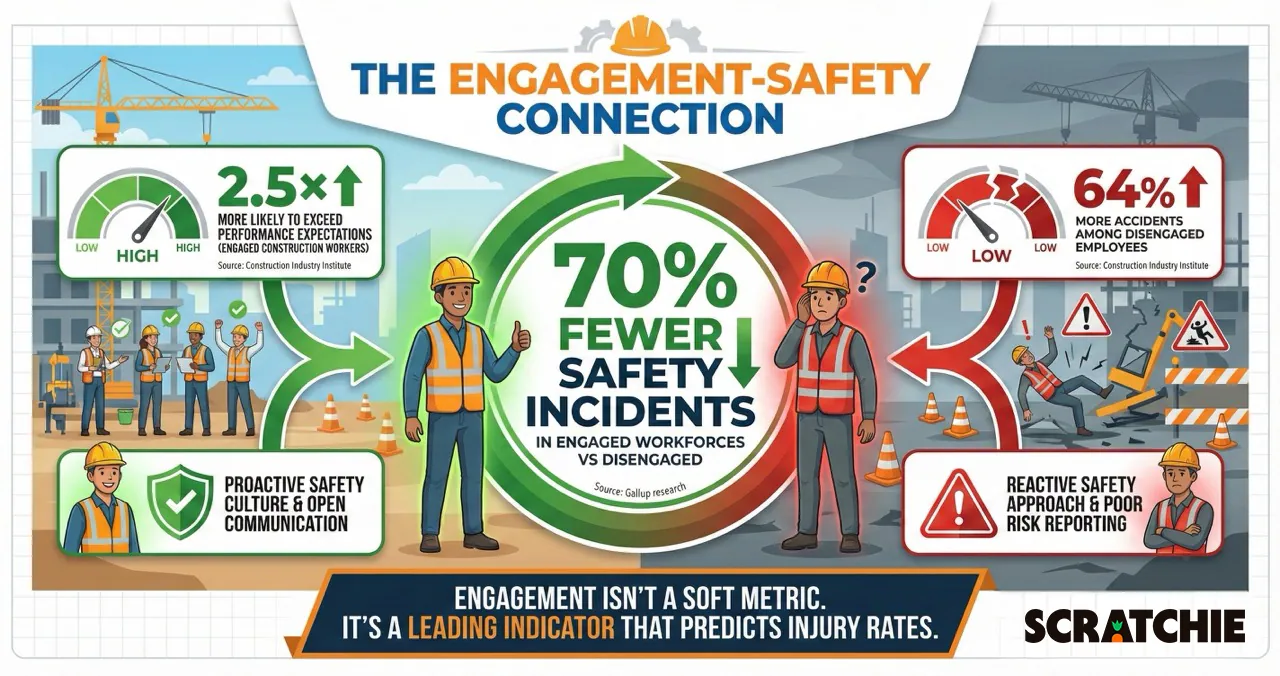
And the consequences are measurable: disengaged employees have 64% more accidents than engaged workers. Gallup research found that engaged workforces experience 70% fewer safety incidents overall.
This isn't a "soft" culture problem. It's a leading indicator that predicts injury rates.
Why tick-and-flick persists (even when everyone knows it's broken)
If everyone knows pre-starts are often ineffective, why does the pattern continue? The research identifies several structural drivers:
Supervisors weren't hired for facilitation skills. Most site supervisors were promoted because they were excellent tradespeople – "great on the tools." Running engaging safety discussions is a completely different skill set, and few receive training in it.
Time pressure creates shortcuts. When the crew is standing there ready to work and the client is watching progress, a three-minute script-reading feels more practical than a fifteen-minute discussion. Production pressure wins.
No feedback loop exists. Workers who find pre-starts useless don't report that feedback upward – because they've learned it doesn't change anything. The system optimises for completion metrics, not quality metrics.
Generic content kills engagement. A study on Finnish construction sites found workers were "rather critical" about safety meetings, questioning whether they were "a waste of time." The meetings were "highly main contractor-led, with subcontractors answering briefly to questions but participating minimally most of the time."
What the research says actually works
NIOSH and academic researchers have identified clear factors that distinguish effective safety communication from tick-and-flick exercises.
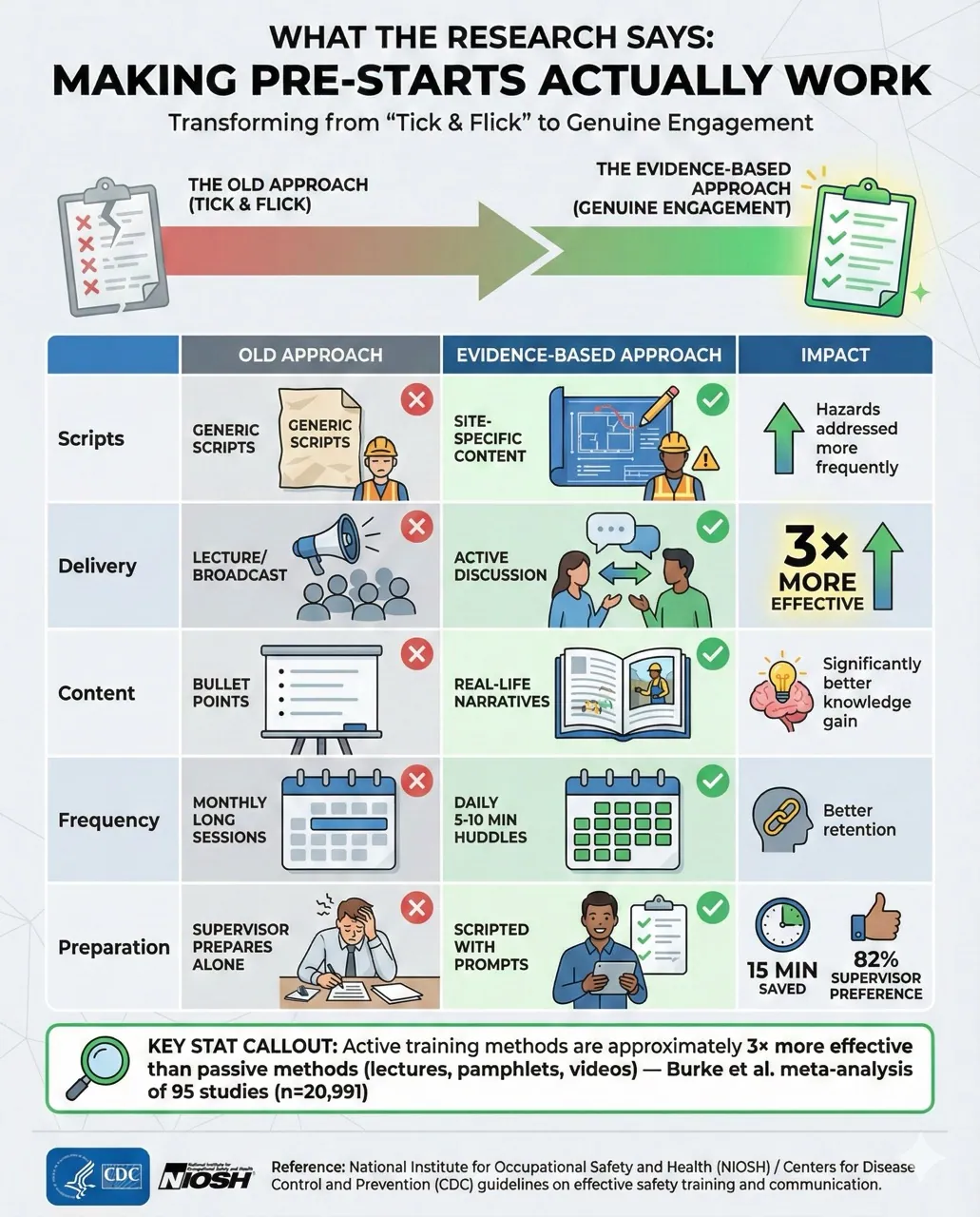
Narratives beat bullet points. A NIOSH-funded study tested toolbox talks in two formats: standard delivery versus versions including real-life stories with discussion questions. Workers who received the narrative version showed significantly better knowledge gain. The effect was strongest among less experienced workers – exactly the population most at risk.
Site-specific beats generic. Research by Kaskutas and colleagues found that using "contextually driven worksite information" significantly improved worker participation. After intervention, hazardous work tasks were discussed more often, and site-specific hazards were identified and addressed more frequently.
Active beats passive. A meta-analysis by Burke and colleagues examining 95 studies (n=20,991) found that as training methods became more engaging – requiring trainees' active participation – workers demonstrated greater knowledge acquisition, and reductions were seen in accidents, illnesses, and injuries. The most engaging methods were approximately three times more effective than lectures, pamphlets, and videos.
Brief and frequent beats long and occasional. Research suggests daily pre-shift huddles of 5-10 minutes focusing on immediate hazards, combined with weekly comprehensive reviews of 30-60 minutes, create a more effective framework than monthly compliance exercises.
82% of supervisors preferred an evidence-based toolbox talk format with scripted text, prompts for discussion, and visual aids – and it saved them 15 minutes in preparation and presentation time compared to preparing their own content (NIOSH construction fatality study).
The transparency solution
The fundamental problem with pre-starts isn't that workers don't care about safety. It's that the current system gives them no reason to engage.
What if the system worked differently?
What if workers could initiate safety conversations – flagging risks they've identified, not just listening to risks management has identified?
What if that upward communication was visible – so leadership could see which sites are generating genuine safety dialogue and which are silent?
What if participation was recognised – so workers who engage get acknowledged, not just workers who comply?
This is the thinking behind tools like digital safety communication platforms that capture not just completion, but content and quality. When workers can raise issues in their own words – with photos, voice notes, or quick categorisation – you get visibility into what's actually happening on the ground.
More importantly, workers start to see that their input matters. That it goes somewhere. That someone's actually listening.
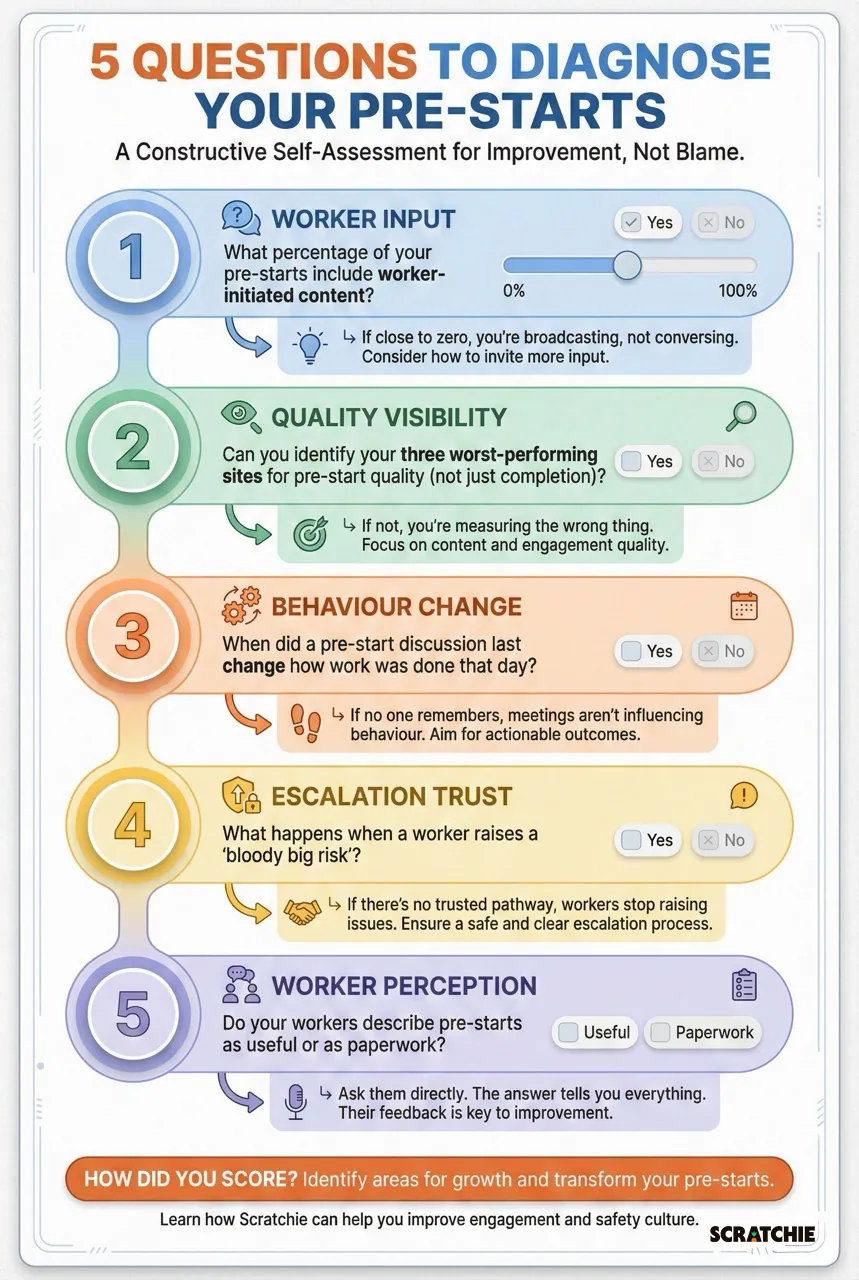
Five questions to diagnose your pre-starts
Before your next safety leadership meeting, try asking these questions:
**1. What percentage of your pre-starts include worker-initiated content?**If it's close to zero, your meetings are broadcast-only. You're missing half the conversation.
**2. Can you identify your three worst-performing sites for pre-start quality (not just completion)?**If you can't, you're measuring the wrong thing.
**3. When did a pre-start discussion last result in a change to how work was done that day?**If no one can remember, the meetings aren't influencing actual behaviour.
**4. What happens when a worker raises a "bloody big risk" in a pre-start?**If there's no escalation pathway that workers trust, they'll stop raising issues.
**5. Do your workers describe pre-starts as useful or as paperwork?**Ask them directly. The answer will tell you everything.
The bottom line
The Fair Work Commission has made the legal standard clear: tick-and-flick doesn't cut it anymore. But the more important point is practical: pre-starts that don't engage workers don't improve safety.
The research is unambiguous. Active participation beats passive attendance. Site-specific content beats generic scripts. Narratives with discussion beat bullet point readings. And visibility into quality – not just completion – is the only way to know if your investment in safety communication is actually working.
Every civil contractor runs pre-starts. The question is whether yours are reducing risk or just reducing legal exposure.
Only one of those outcomes actually keeps people safe.
SOURCES REFERENCED
- GYST Consulting. Pre-Start Meetings: You Snooze, You Lose. https://www.gystconsulting.com.au/pre-start-meetings-you-snooze-you-lose
- Fair Work Commission (2024). Ramlan Abdul Samad v Phosphate Resources Ltd. Deputy President O'Keeffe. October 2024. Cited in HR Daily and Colin Biggers & Paisley analysis.
- Fair Work Commission (2025). Hancock v HPS. Deputy President Judith Wright. https://www.mcw.com.au/fair-work-commission-requires-employers-to-notify-employees-of-policy-changes/
- Safe Work Australia. WHS Perceptions in the Construction Industry Survey. https://www.safeworkaustralia.gov.au/system/files/documents/1702/whs-perceptions-construction-industry.pdf
- National Safety Council. Construction Workers Say Safety Takes a Back Seat to Productivity. https://www.cbia.com/news/hr-safety/construction-workers-say-safety-takes-a-back-seat-to-productivity/
- Gallup. Research on engaged workforces and safety incidents. Cited in Culture Monkey analysis. https://www.culturemonkey.io/employee-engagement/employee-engagement-in-construction-industry/
- SafeSite HQ (2023). Employee Engagement Improves Safety. Research showing disengaged employees have 64% more accidents. https://safesitehq.com/employee-engagement-improves-safety/
- NIOSH/CDC (2019). Narrative Toolbox Talks Study. Published in American Journal of Industrial Medicine. https://pmc.ncbi.nlm.nih.gov/articles/PMC6537900/
- Kaskutas et al. Toolbox Talk Effectiveness Research. Published in Professional Safety and Washington University Digital Commons. https://digitalcommons.wustl.edu/cgi/viewcontent.cgi?article=1082&context=ohs_facpubs
- Burke et al. Meta-analysis of Safety Training Effectiveness. 95 studies, n=20,991. Published in Journal of Applied Psychology. https://pmc.ncbi.nlm.nih.gov/articles/PMC1470479/
- NIOSH/CDC. Construction Fatality Toolbox Talk Study. https://stacks.cdc.gov/view/cdc/225115
- Finnish Construction Site Safety Meetings Study. Published in IGLC conference proceedings. https://iglcstorage.blob.core.windows.net/papers/attachment-6a3d9cb9-ea68-4171-b6fb-1b868bdced38.pdf
- RMIT Centre for Construction Work Health and Safety Research (2017). Work Health and Safety Culture in the ACT Construction Industry. https://www.act.gov.au/__data/assets/pdf_file/0007/2794480/Work-Health-Safety-Culture-ACT-Construction-Industry.pdf