When Your Safety System Talks to Your Recognition System: The Integration That Changed McDonald's Safety Culture
McDonald's Australia went from buried paperwork to a 500% increase in safety participation. The difference wasn't more training or stricter policies – it was making their safety system digital, accessible, and connected. When hazard reports take 30 seconds and recognition follows automatically, culture transforms.
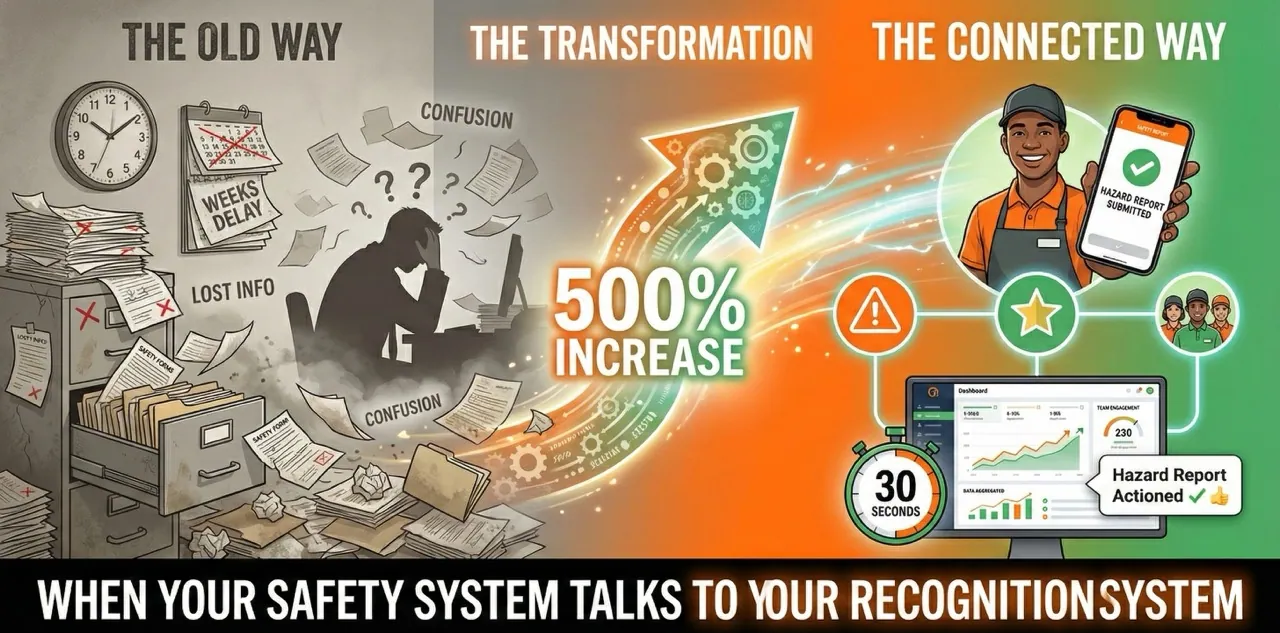
Here's a question that keeps safety leaders awake at night: when was the last time one of your crew members voluntarily reported a hazard?
Not because they had to. Not because a supervisor was watching. But because they genuinely believed it would make a difference.
If you're running a paper-based safety system – or even a clunky digital one that feels like homework – the honest answer is probably "rarely."
McDonald's Australia faced the same problem. Then they changed everything.
The McDonald's Transformation: 500% More Participation
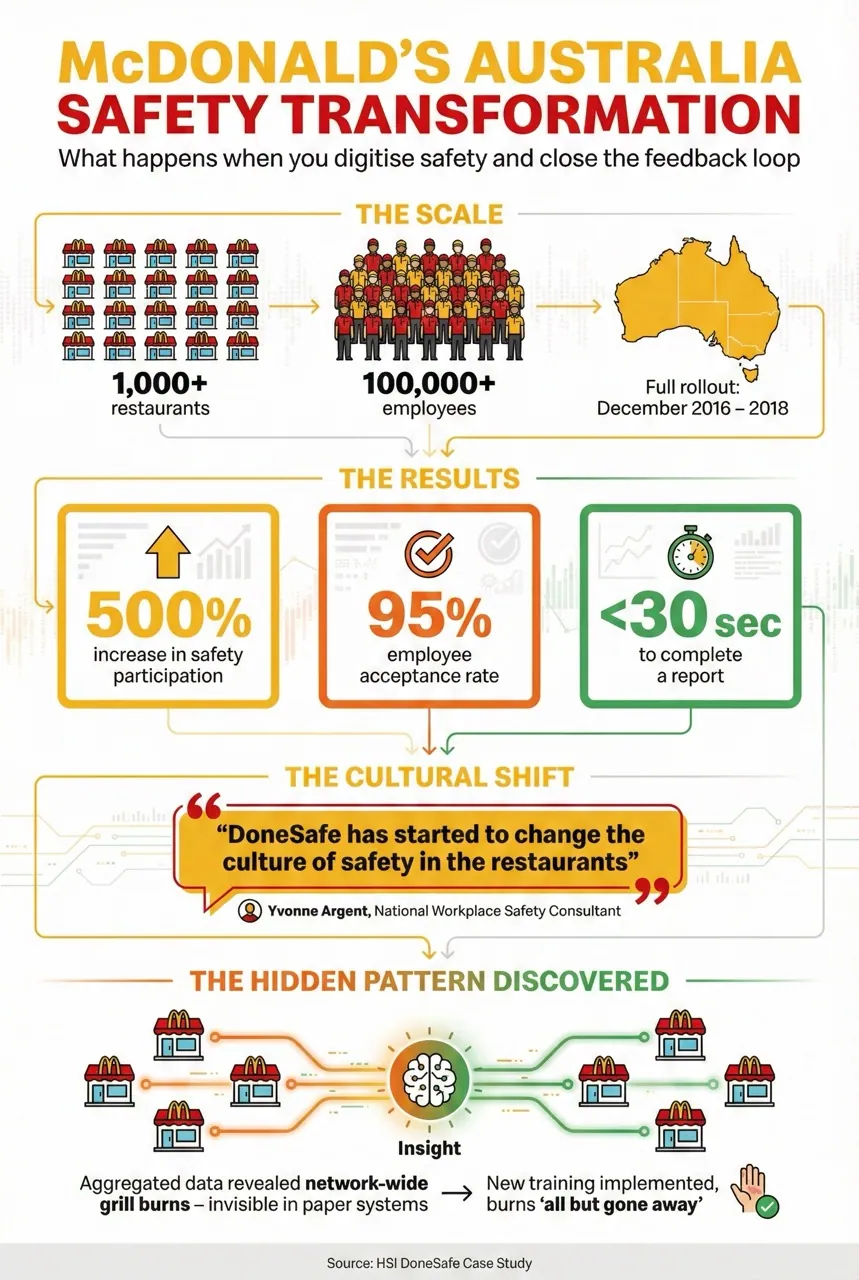
In December 2016, McDonald's Australia began rolling out HSI DoneSafe across their network. By 2018, every one of their 1,000+ restaurants and 100,000+ employees was on the platform (HSI DoneSafe McDonald's Case Study).
The results were striking.
500% increase in employee participation in safety reporting – across all organisational levels, from crew members to executives (HSI DoneSafe Case Study; DoneSafe Retail-Hospitality).
95% employee acceptance rate – the vast majority accepted the change immediately, largely because frontline workers and managers had participated in the trial phase and shaped the system build (HSI DoneSafe Case Study; DoneSafe Why DoneSafe).
Under 30 seconds to complete a safety report on any device – removing the friction that made paper-based reporting feel like a burden (HSI DoneSafe Case Study; DoneSafe Retail-Hospitality).
But the numbers only tell part of the story. The real transformation was cultural.
What Was Actually Broken
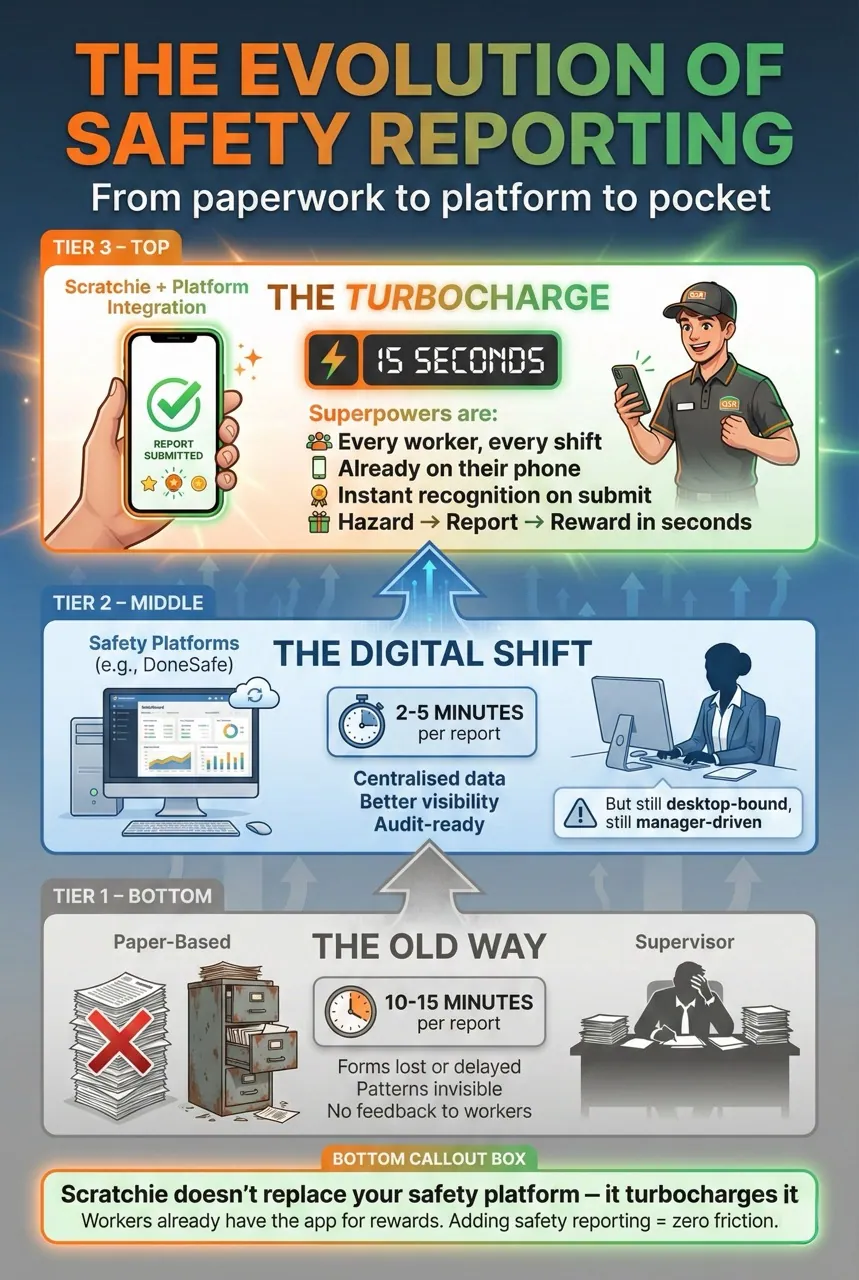
Before DoneSafe, McDonald's ran on paper. Safety forms were completed by hand, collected from restaurants, transported to headquarters, manually entered into systems, and eventually – sometimes weeks later – analysed.
The problems with this approach were systemic.
Invisible patterns. When McDonald's installed new grills across their network, employees at various locations were getting burned. But nobody realised the extent of the problem until they could see aggregated data across all sites. With paper, that pattern was invisible – just isolated incidents at individual restaurants that never connected (HSI DoneSafe Case Study PDF).
Delayed response. As National Workplace Safety Consultant Yvonne Argent noted, there was "a whole swathe of information that we weren't seeing quickly enough" (DoneSafe Case Study). By the time paper forms made their way through the system, the hazard had either caused more harm or been forgotten entirely.
Administrative burden. Safety teams spent their time on logistics – collecting forms, chasing missing information, manually entering data – rather than actually preventing injuries. The EHS team was trapped in administrative work when they should have been doing high-level preventative activities (HSI DoneSafe Case Study).
No feedback loop. When a crew member took the time to report a hazard, they rarely found out what happened next. Did anyone read it? Did it make a difference? Without that feedback, the motivation to report again disappeared.
What Changes When You Go Digital
The shift from paper to digital safety management isn't just about efficiency. It's about visibility, speed, and connection.
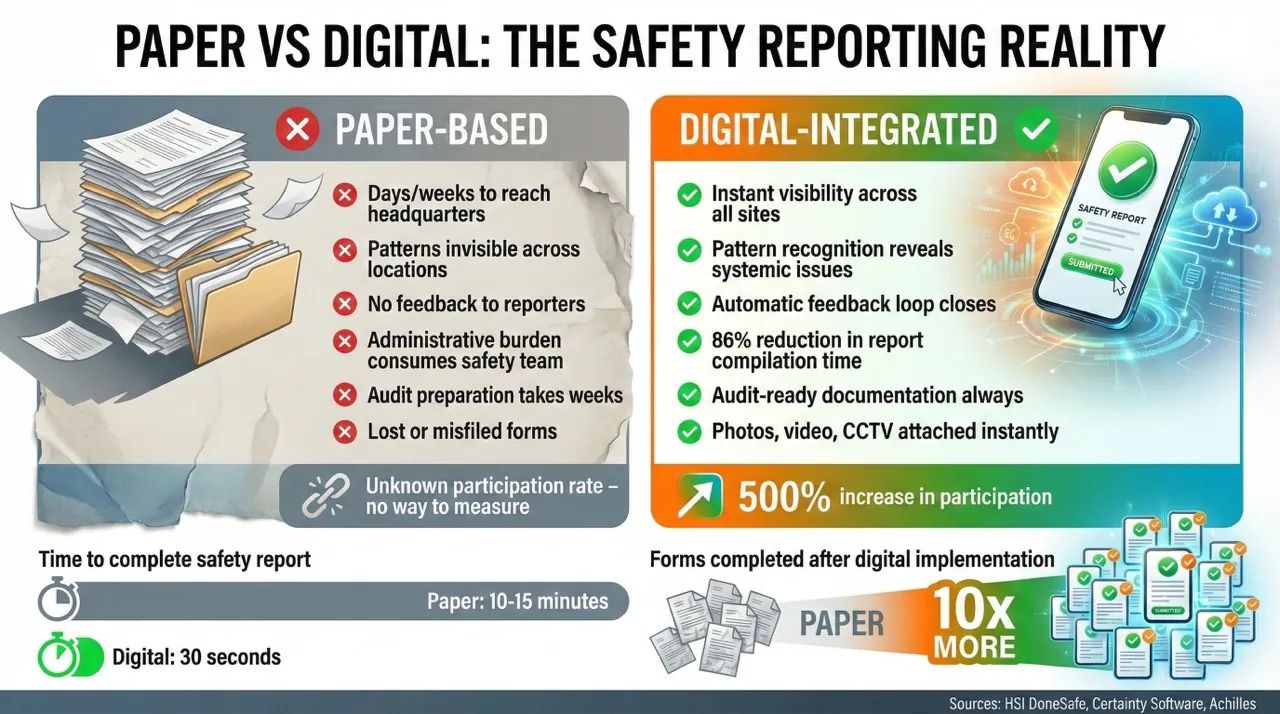
Real-time transparency. Managers no longer had to wonder if safety issues were isolated to one location or network-wide. Digital reporting provided instant visibility, allowing the business to respond to hazards immediately rather than waiting days or weeks (HSI DoneSafe Case Study).
Pattern recognition. The grill burn example is instructive. Once McDonald's could aggregate data across all locations, they implemented new safety measures and training. The burns "have all but gone away" (HSI DoneSafe Case Study PDF). That pattern would never have emerged from paper forms sitting in filing cabinets.
Rich information. Workers could suddenly upload photos, CCTV footage, and videos directly to incident records, providing managers with all relevant information instantly – a capability impossible with paper (HSI DoneSafe Case Study; DoneSafe Retail-Hospitality).
Cultural shift. As Argent observed: "From a cultural perspective across all levels of senior management through corporate and in the restaurants, DoneSafe has started to change the culture of safety in the restaurants" (HSI DoneSafe Case Study). Safety rose in prominence because it became visible.
The Recognition Connection: Why This Matters for Engagement
Here's where it gets interesting for anyone thinking about workforce engagement.
McDonald's 500% participation increase didn't come from mandates or penalties. It came from making reporting easy, fast, and – critically – from closing the feedback loop.
When workers see that their reports lead to action, reporting becomes meaningful rather than bureaucratic. That's the foundation of recognition-based safety programs.
Research consistently shows that safety incentive programs work – but with important nuances:
Leading indicators beat lagging indicators. Programs that reward hazard reports and near-miss identification are more effective than those that simply reward "no injuries." The latter can incentivise underreporting; the former drives proactive safety culture (PMC research on safety incentives; Field1st).
Immediate recognition outperforms delayed rewards. A PMC study found that surprising, immediate incentive systems had greater positive impact in the first six months compared to traditional quarterly programs (PMC 2015).
Frequent small recognition beats infrequent large rewards. Research shows frequent, low-price incentives have greater positive impact than infrequent large rewards – aligning perfectly with daily recognition approaches (PMC 2015).
Non-financial recognition matters. While financial rewards work, non-financial recognition – public acknowledgment, badges, leaderboard positions – creates sustained engagement. Manufacturing firms implementing safety rewards programs reported 25% improvement in safety compliance (BucketList Rewards).
The construction industry provides compelling evidence. One company implementing a leading-indicator-based safety communication and recognition program that incentivised safe working conditions ran the redesigned program for six months, demonstrating sustained improvements in hazard reporting and safe conditions (PMC 2017).
The Administrative Reality: Time Saved Is Time Redirected
Let's talk about what digital transformation actually means for operations.
10x more forms completed. Organisations report completing up to ten times more safety forms after implementing digital solutions (Certainty Software). When reporting takes 30 seconds instead of 10 minutes of paperwork, participation explodes.
86% reduction in report compilation time. One case showed automated compliance tracking reduced report compilation from over a week to just one day (Achilles).
Instant audit readiness. Digital systems allow efficient access to specific reports and audit trails that have been automatically maintained and organised. During regulatory audits or inspections, companies can quickly search and retrieve any documentation required (SiteDocs; Miller Cares).
Reduced regulatory interventions. Organisations demonstrating proactive safety technology implementation face fewer regulatory interventions. One calculation showed reducing safety-related regulatory interventions from 4 to 1 annually saved $66,000 in management time and consultant fees (Red Edge Resources).
For QSR operations running on tight margins with stretched management, these efficiency gains aren't nice-to-haves. They're the difference between safety being a burden and safety being sustainable.
The ROI Case: Numbers That Matter to Finance
Safety technology investment delivers measurable returns.
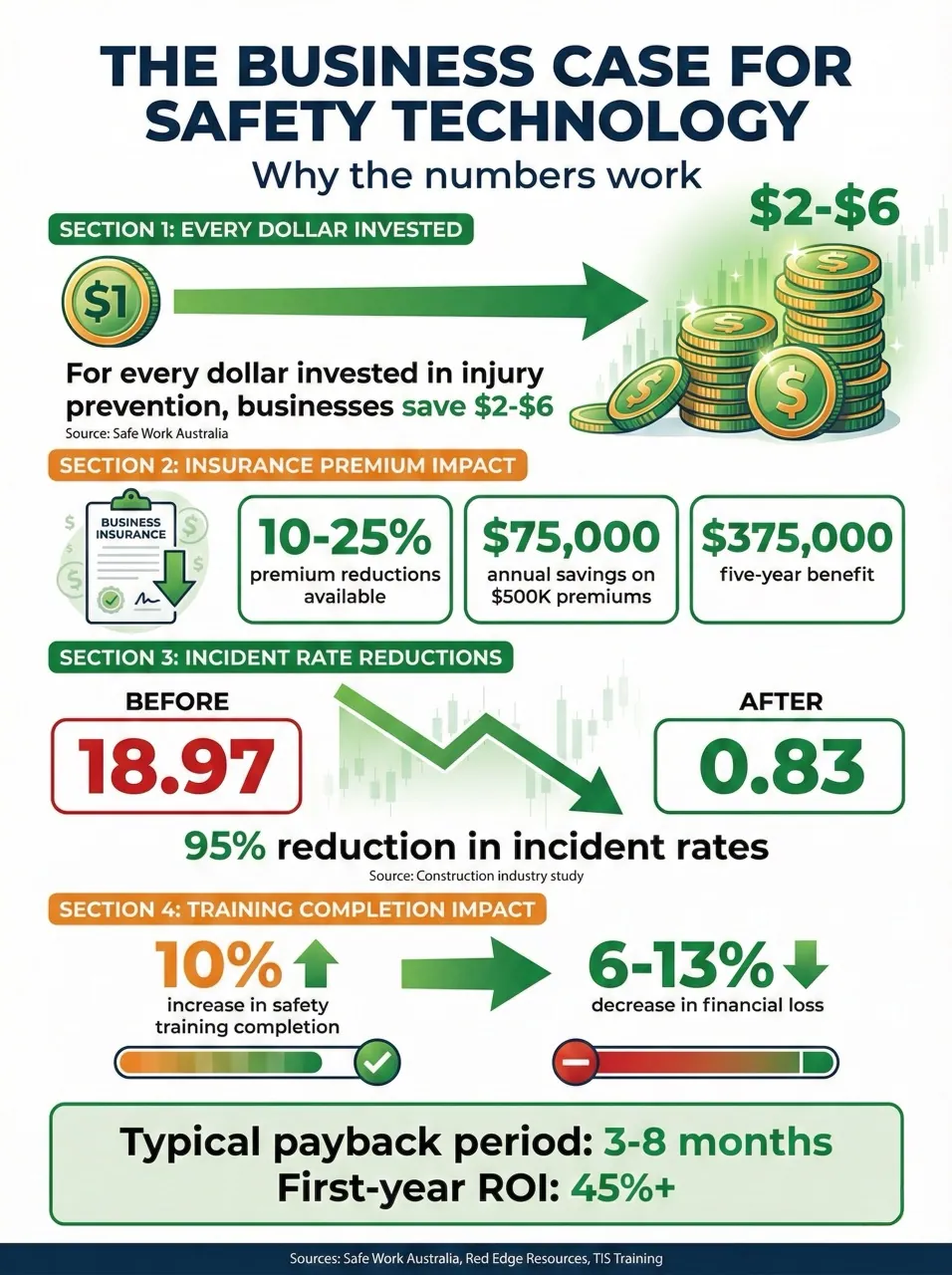
Safe Work Australia calculates that for every dollar invested in injury prevention, businesses save between $2 and $6 through reduced medical costs, less downtime, lower insurance premiums, and improved productivity (Action OHS Consulting).
Insurance premium reductions of 10-25% are available for operations implementing comprehensive safety systems. An operation with $500,000 annual premiums receiving a 15% discount saves $75,000 annually – $375,000 over five years (Powers Insurance; Red Edge Resources).
Experience Modification Rate (EMR) improvements directly impact workers' compensation costs. Safety software provides insights to target the biggest risk contributors, bringing down the number and cost of claims. Lowering EMR from 1.2 to 1.0 saves $0.20 per $100 of payroll premium (SafeSite HQ).
Incident rate reductions are dramatic when systems are properly implemented. Construction companies implementing safety incentives saw incident rates drop by over 95% – from 18.97 to 0.83 (University of Wisconsin-Stout thesis research).
A 10% increase in safety training completion decreases financial loss by 6-13% (TIS Training).
The comprehensive ROI picture for a mining operation with collision avoidance technology showed first-year ROI of 45% and payback period of 8.3 months, with five-year net benefit of $5.9 million (Red Edge Resources). While QSR operations are different, the principle holds: safety technology pays for itself quickly.
Why This Matters More for Hospitality
Australian hospitality faces specific safety challenges that make integrated digital solutions even more critical.
Injury rates 38% higher than average. The accommodation and food services sector has an incidence rate of 58.6 injuries and diseases per 1,000 workers – significantly above the overall Australian workforce rate (Safe Work Australia).
Young workers at disproportionate risk. The majority (42%) of young workers are employed in Retail Trade (21%) and Accommodation and Food Services (21%) – the highest concentration of any sectors (SafeWork NSW). Burns account for 20% of serious claims among 15-19 year-olds, more than double the industry average of 8% (Safe Work Australia).
Injuries among workers under 18 nearly doubled in the past five years, from 150 cases in 2020 to 269 in 2024, according to South Australian data (SA Unions).
Body stressing injuries dominate – 32% of serious claims, primarily from muscular stress while lifting, carrying, or putting down objects (Safe Work Australia).
Psychosocial hazards are rising rapidly. Mental health claims now account for 10.5% of serious claims nationally, with a 97.3% increase compared to 10 years ago (Safe Work Australia Key Statistics 2024).
Young workers often lack experience, receive inadequate training, and may be reluctant to speak up about safety concerns. These vulnerabilities make them particularly suited to benefit from digital safety platforms that simplify reporting and encourage participation (Australian Retailers Association; SafeWork NSW).
The Integration Imperative: Making Systems Talk
The real power emerges when safety systems connect with other platforms.
HSI DoneSafe offers 60+ interconnected modules covering incident management, hazard reporting, risk assessment, audits and inspections, contractor management, training, and workers' compensation claims (DoneSafe Modules). But more importantly, it integrates with external systems through REST API, SFTP, and SSO (SAML 2.0, Okta, Microsoft Azure AD) (DoneSafe EHSQ Capabilities).
What does this mean in practice?
Automatic employee synchronisation. When new employees join via your HR system, they're automatically added to safety training, induction tracking, and incident reporting systems. No manual data entry, no forgotten onboarding steps (HRIS integration research).
Unified compliance tracking. Training records from Learning Management Systems sync with safety systems and HR records, maintaining complete compliance visibility across platforms (Integration research).
Streamlined claims management. Injury and claims management modules integrate with payroll systems to automatically populate claim forms with compensation data, calculate workers' compensation payments, and track return-to-work impacts (DoneSafe Injury Claims Management).
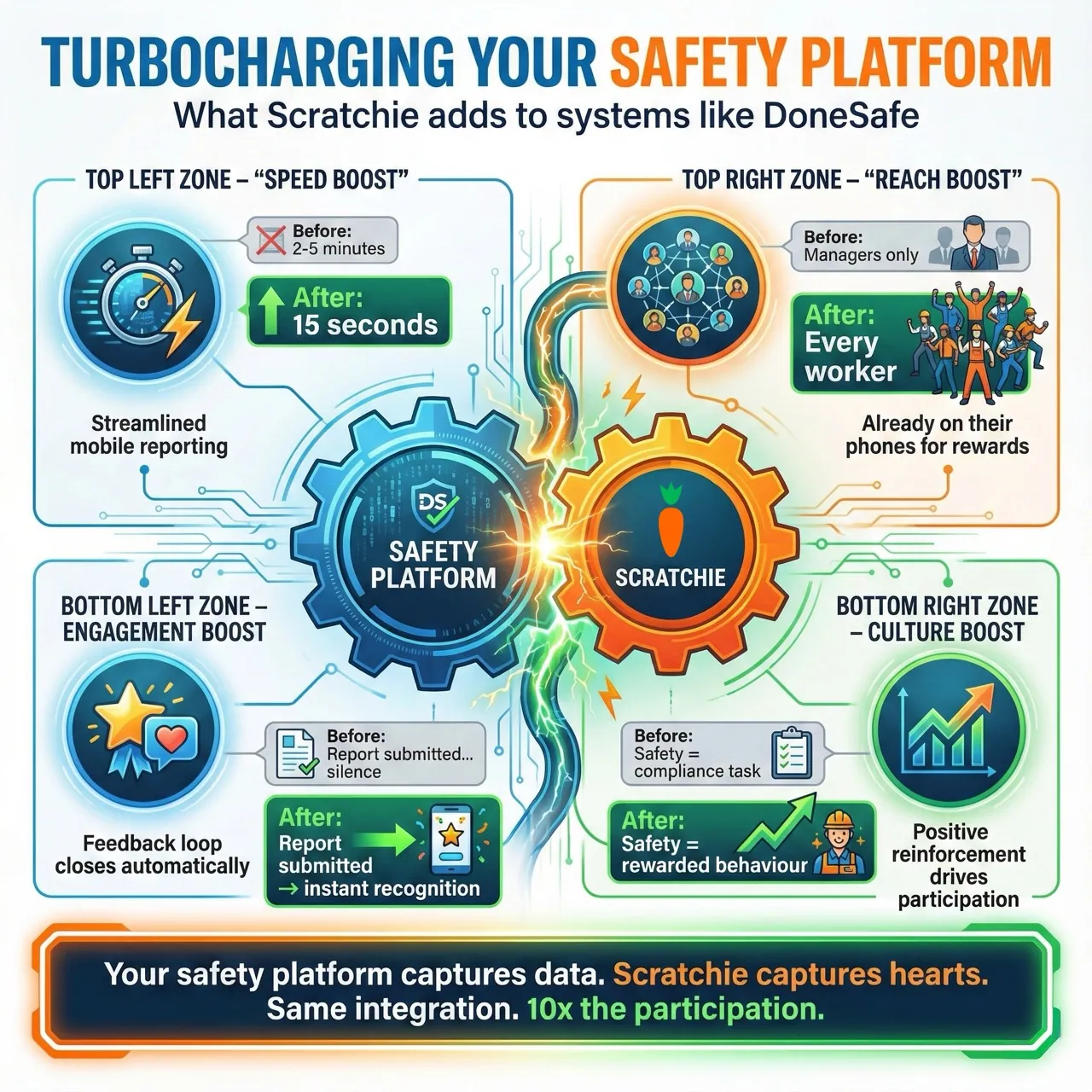
Recognition triggers. When safety systems integrate with recognition platforms, positive behaviours can be automatically acknowledged. A hazard report submitted triggers instant recognition. A near-miss reported and resolved becomes a "safety win" celebrated publicly.
This last point is where the real culture change happens. When the feedback loop closes automatically – when doing the right thing is immediately recognised – behaviour shifts.
What Integration Actually Looks Like
Imagine this workflow in your operation:
A 19-year-old crew member notices a wet floor near the fryer that wasn't there 10 minutes ago. The mop bucket nearby has a slow leak.
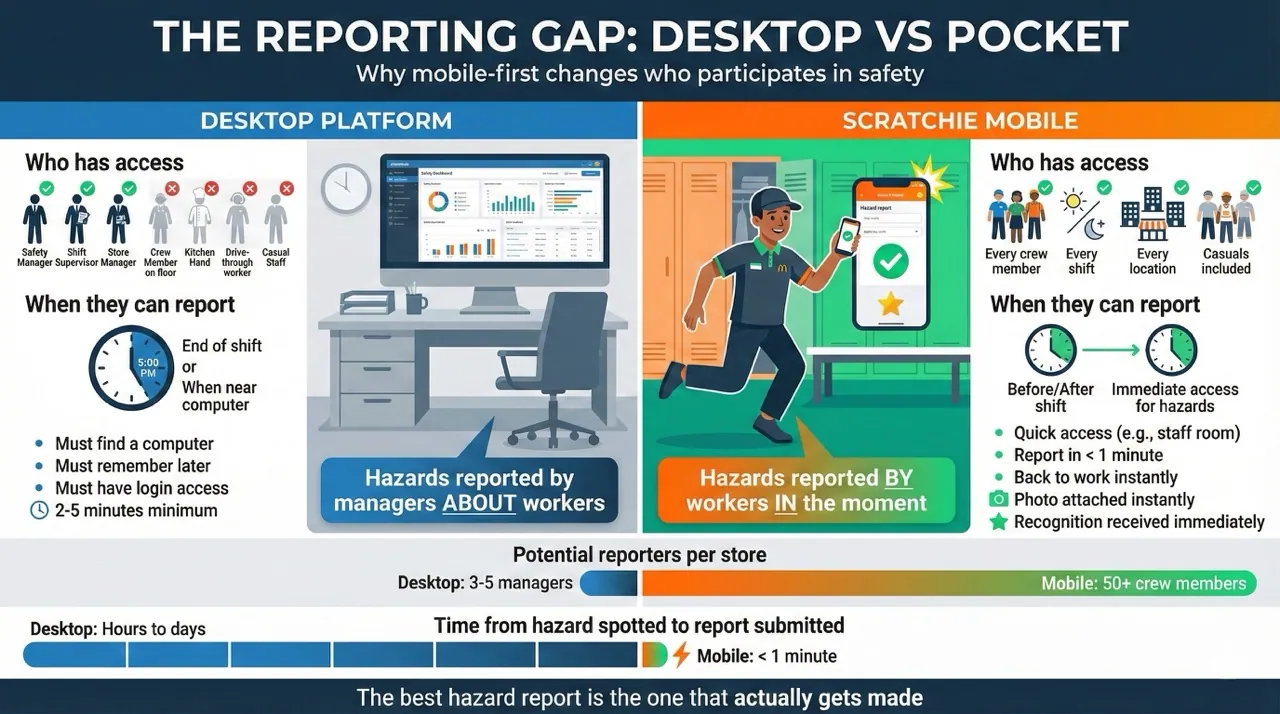
Without integration: She might mention it to a supervisor if she remembers. Maybe a paper form gets filled out eventually. Nothing visible happens. She never knows if it mattered.
With integration: She opens the app on her phone – the same app she uses for checking her roster and receiving recognition. Thirty seconds later, she's submitted a hazard report with a photo. The system automatically notifies the shift manager. When the issue is resolved, she gets a notification: "Your hazard report has been actioned." She receives 50 points and a public acknowledgment in the team feed: "Great catch on the mop bucket leak – that's how we keep each other safe."
The mop bucket gets fixed. But more importantly, she's just learned that reporting hazards matters and gets noticed. She'll do it again.
Multiply that across 100,000 employees and you get McDonald's 500% participation increase.
Building This for Your Operation
The McDonald's case study demonstrates what's possible. Here's how the principles translate to QSR operations of any size:
Start with accessibility. If reporting a hazard takes more than 60 seconds or requires finding a computer, participation will be low. Mobile-first, app-based reporting is non-negotiable for frontline operations.
Close the feedback loop. Workers need to see that their reports lead to action. Automated notifications when issues are resolved, visible tracking of report-to-resolution, and public acknowledgment of contributions all reinforce the behaviour.
Recognise leading indicators. Don't just track injuries – celebrate hazard reports, near-miss identification, safety training completion, and proactive behaviours. Make the things you want more of visible and rewarded.
Aggregate and act on patterns. The power of digital systems is pattern recognition. Use aggregated data to identify systemic issues – like McDonald's grill burns – that would be invisible in paper-based systems.
Integrate where possible. Every manual data transfer is friction. Connect safety systems with HR, payroll, rostering, and recognition platforms to create seamless workflows that reduce administrative burden.
Make it sustainable. Safety teams shouldn't spend their time chasing paperwork. Digital automation frees them for the preventative work that actually reduces incidents.
The Culture Shift That Follows
McDonald's didn't just implement software. They changed how safety was perceived across their organisation.
"From a cultural perspective across all levels of senior management through corporate and in the restaurants, DoneSafe has started to change the culture of safety in the restaurants." – Yvonne Argent, National Workplace Safety Consultant, McDonald's Australia (HSI DoneSafe Case Study)
That cultural shift – from safety as compliance burden to safety as shared responsibility – is what every QSR operator should be aiming for.
The technology enables it. The integration amplifies it. But the transformation is fundamentally about making safety visible, responsive, and recognised.
When your 19-year-old crew member believes her hazard report matters – and sees evidence that it does – you've built something more valuable than any compliance checklist.
You've built a culture where everyone looks out for everyone else.
And that's worth far more than a 500% increase in any metric.
Scratchie integrates with HSI DoneSafe to automatically recognise safety behaviours – turning hazard reports, near-miss identification, and safety training completion into visible wins. When systems talk, culture transforms. Email james@scratchie.com to learn how the integration works.
SOURCES REFERENCED
- HSI DoneSafe – McDonald's Australia Case Study (website and PDF)
- DoneSafe – Retail-Hospitality Safety Software page
- DoneSafe – Why DoneSafe page
- DoneSafe – Modules at a Glance
- DoneSafe – EHSQ Capabilities (integration documentation)
- DoneSafe – Injury Claims Management module
- PMC (2015) – Safety incentive programs research (immediate vs quarterly rewards)
- PMC (2017) – Construction safety communication and recognition programs
- Field1st – Leading vs lagging indicators and near-miss reporting
- BucketList Rewards – Safety recognition programs (25% compliance improvement)
- Certainty Software – Manual vs automated safety audits (10x more forms)
- Achilles – Technology and safety compliance (86% time reduction)
- SiteDocs – Digital vs paper safety documentation
- Miller Cares – Digital systems for safety reporting
- Red Edge Resources – ROI of safety technology ($66K savings, payback calculations)
- Safe Work Australia – Key WHS Statistics 2024
- Safe Work Australia – Accommodation and Food Services industry data
- SafeWork NSW – Young workers at risk statistics
- SA Unions – Young worker injury trends (150 to 269 cases)
- Australian Retailers Association – Protecting young workers in retail
- Action OHS Consulting – $2-6 return per $1 invested
- Powers Insurance – Safety technology and insurance costs (10-25% premium reductions)
- SafeSite HQ – Workers compensation savings and EMR
- TIS Training – ROI of safety training (10% increase = 6-13% loss reduction)
- University of Wisconsin-Stout thesis – 95% incident rate reduction