What Union Pacific Learned About Safety That Most Companies Get Wrong
Union Pacific achieved a 54% injury reduction by making unions equal partners in safety program design. Research shows joint union-management approaches deliver half the injury rates of management-only programs. This post examines what makes recognition programs succeed in heavily unionised environments, and why most fail.
What Union Pacific Learned About Safety That Most Companies Get Wrong
Recognition programs don't work in unionised environments. The union will oppose it. Workers will game it. It'll create more problems than it solves.
That's the assumption. Here's the reality.
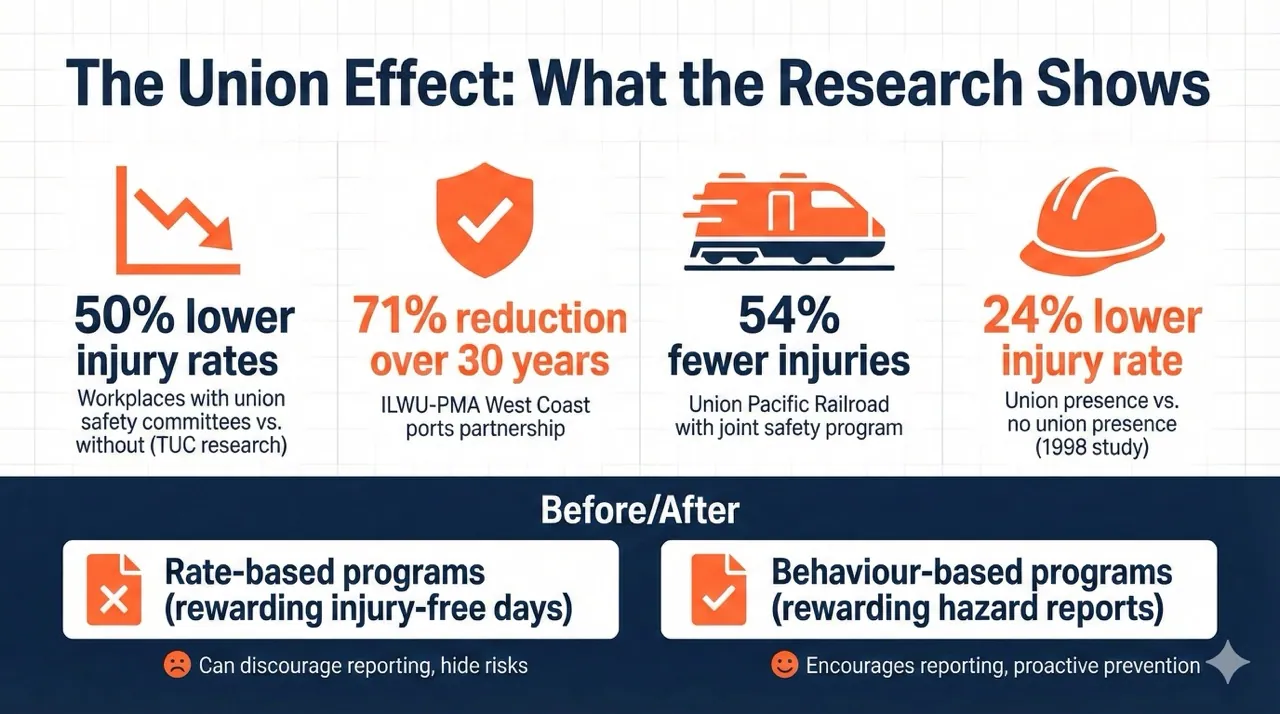
Union Pacific Railroad – 31,000 employees, one of the most heavily unionised workforces in America, operating heavy mobile plant across 24/7 operations with constant fatigue risks – achieved a 54% reduction in employee injuries over a decade. Not by working around the unions. By making them co-owners of the program.
On the waterfront, the story is even more striking. The International Longshore and Warehouse Union (ILWU) and Pacific Maritime Association (PMA) partnership has delivered a 71% reduction in lost-time injuries over three decades, achieving the lowest injury rates in West Coast port history (Pacific Maritime Association regulatory submission).
In Australia, stevedoring once had a fatality rate 14 times the national average. Six MUA members were killed between 2007 and 2012 (MUA submission to Australian Parliament). Following union-led advocacy for reform, the industry achieved a transformation, with zero fatalities in MUA-organised worksites since May 2014.
The common thread? Programs designed with unions, not despite them.
Why most safety incentive programs fail in union environments
Union opposition to safety incentive programs isn't obstruction. It's often entirely rational.
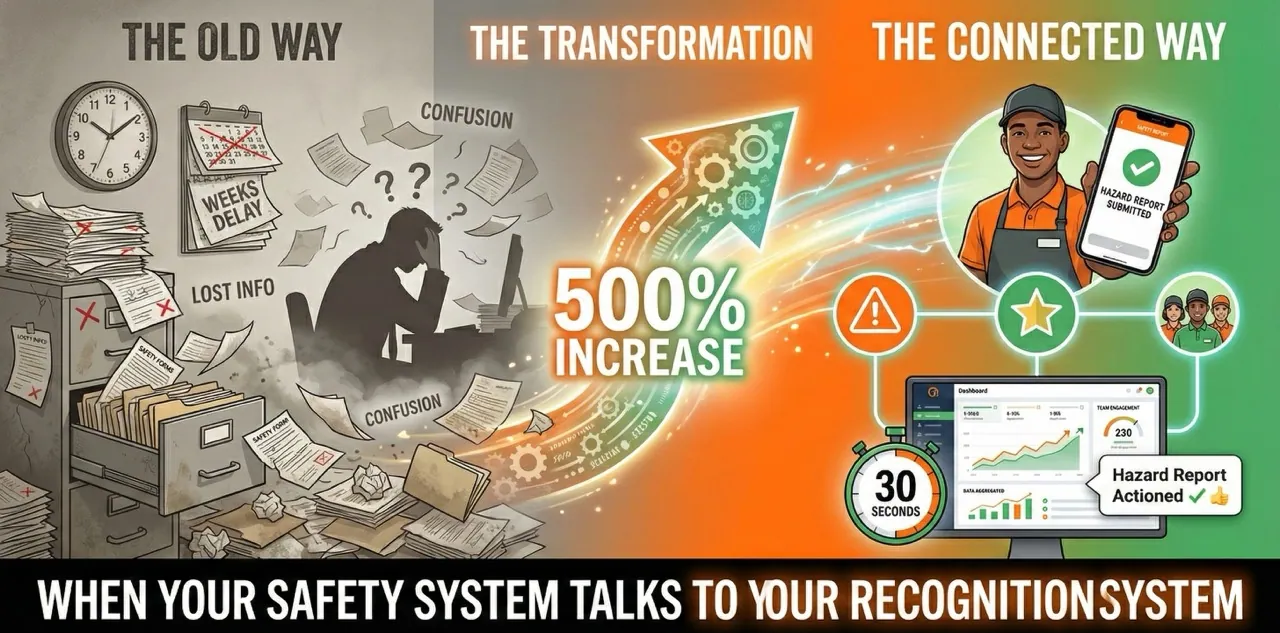
The primary concern is straightforward: traditional "Safety Bingo" programs – those rewarding injury-free periods – create powerful incentives to hide injuries rather than prevent them.
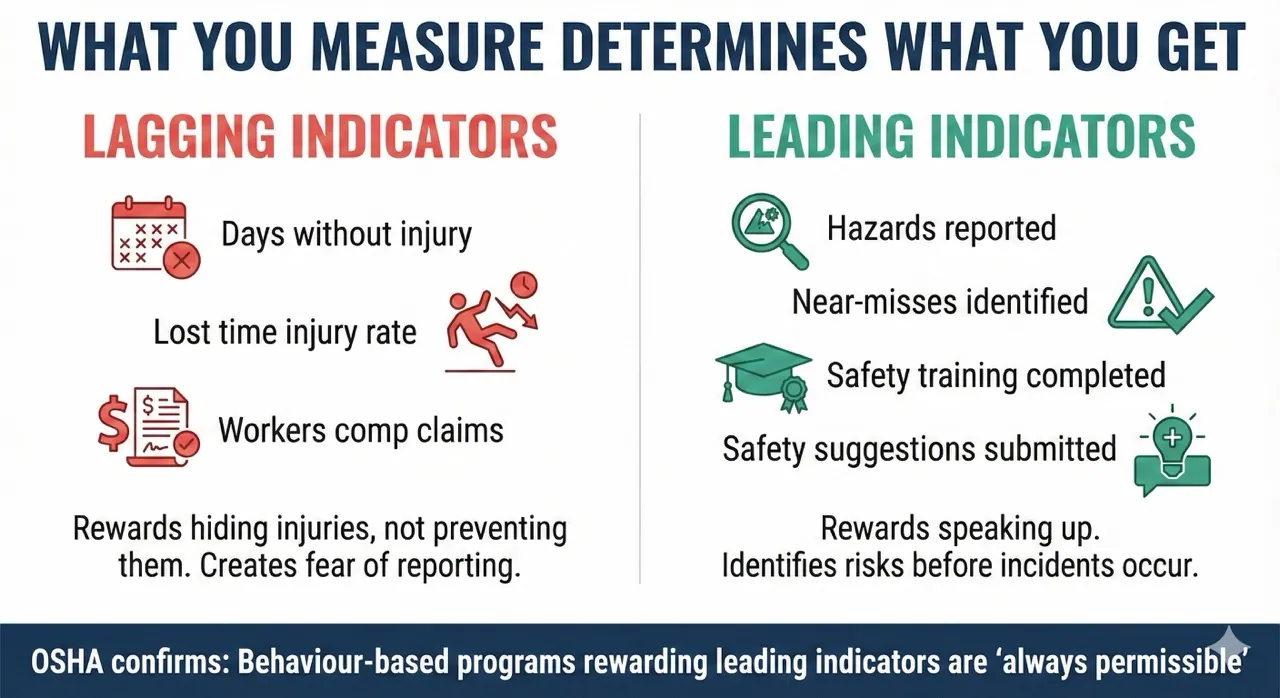
A 2012 Government Accountability Office report confirmed that rate-based safety incentive programs "may discourage reporting of injuries and illnesses." OSHA explicitly warned that "incentive programs that unintentionally or intentionally provide employees an incentive not to report injuries" can violate federal law (OSHA Standard Interpretation, 2012).
The evidence isn't theoretical. A federal lawsuit against BNSF Railway exposed systematic injury suppression. Testimony established that the company's Incentive Compensation Plan created financial pressure on managers to suppress reports: "It will also impact your potential for a promotion. BNSF has what they call succession planning. And to be considered for a potential promotion, you need to rate high on your performance management" (BNSF lawsuit testimony).
In 2025, Union Pacific was deemed a "serial violator" of the Federal Railroad Safety Act by OSHA, ordered to pay over $300,000 in damages for retaliating against a worker who reported an injury (SMART-TD Union statement).
When unions oppose safety incentive programs, they're often pointing to real risks that management has overlooked.
The Union Pacific model: What they did differently
Union Pacific's transformation began in crisis. In 1997, seven mainline train accidents killed five employees and two members of the public. Four additional yard workers died in switching accidents. A Federal Railroad Administration (FRA) audit found the company "lacked many safety initiatives which may have addressed or prevented many accidents" (FRA Union Pacific Audit).
What followed became a model for labour-management safety partnerships.
The FRA didn't just impose regulations. It required Union Pacific to "promote railroad safety teams that include employee representatives and invite employee representatives to participate as equal partners at all levels of the safety process."
Union Pacific established a Joint Safety Steering Committee composed of representatives from rail labour, management, and the FRA. Six subordinate committees addressed specific concerns: crew management, train dispatching, fatigue, training, culture, and inspection.
The "Total Safety Culture" program included peer-based observation – the "Changing At-Risk Behavior" (CARB) process – where trained employees observed colleagues and provided constructive feedback. Research documented "improved safety culture and labor-management relations" as a direct result (Journal of Occupational Safety research).
The results in year one alone: 23% reduction in reportable injuries and 26% decline in lost workday cases. Over the following decade, the injury rate dropped 54%, reaching the lowest in company history.
The waterfront proof: ILWU-PMA joint safety committees
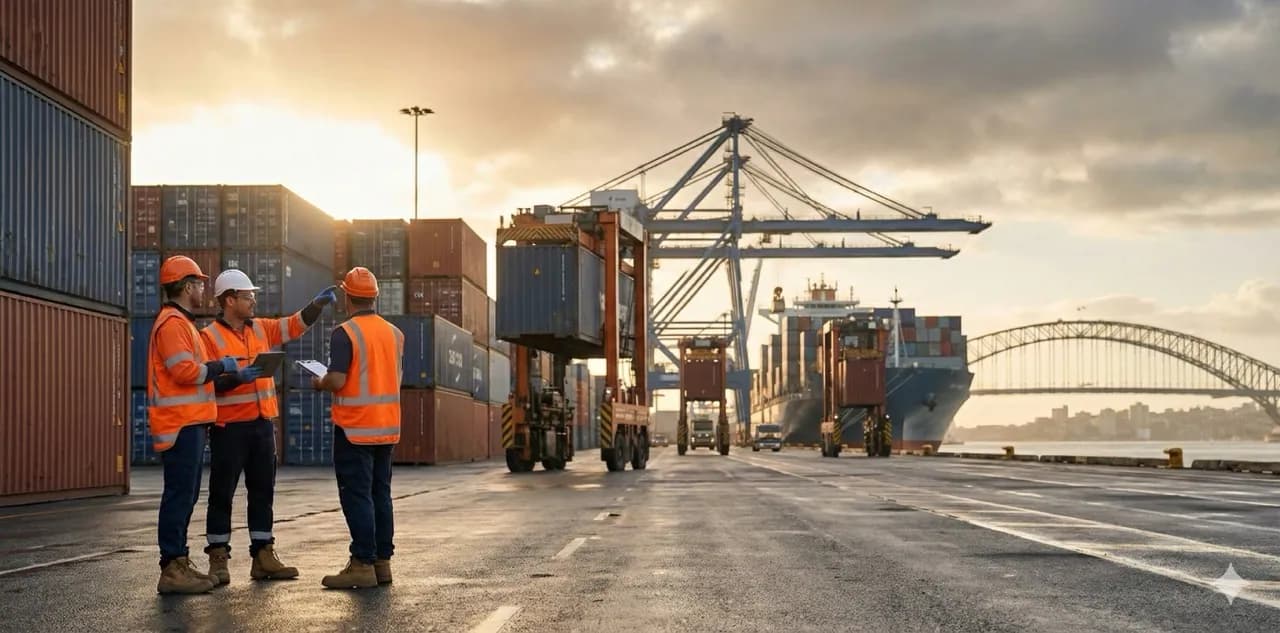
If you want evidence that union partnership works in port operations specifically, look to the US West Coast.
The ILWU-PMA safety partnership operates through Local Joint Accident Prevention Committees in each of the 29 ports covered by the agreement, overseen by a coastwide Pacific Coast Marine Safety Committee (ILWU-PMA Safety Code).
The Pacific Coast Marine Safety Code dates back to 1929 and has been incorporated into the collective agreement since 1946. Its guiding philosophy is unambiguous:
"In a question of convenience vs. safety, safety first. In a question of comfort vs. safety, safety first. In a question of tonnage vs. safety, safety first."
The joint committees have real authority: they discuss and clarify safety code language, address emerging hazards, recommend rule changes, and negotiate specific memoranda on issues from high-visibility vests to diesel emission controls.
The PMA's official assessment: the partnership "has been extremely successful at reducing the Days Away from Work rate." Lost-time injuries dropped 71% over three decades.
The design principles that earn union buy-in
Across industries, union-endorsed safety programs share consistent characteristics.
Focus on leading indicators, not lagging outcomes. Rather than rewarding "days without injury" (which encourages concealment), successful programs recognise hazard identification, near-miss reporting, and training participation. OSHA guidance confirms that behaviour-based programs rewarding these activities are "always permissible" (OSHA Standard Interpretation, 2018).
The NSW Mine Safety Advisory Council – comprising the NSW Minerals Council, CFMEU, and Australian Workers' Union – jointly agreed that "schemes are no longer linked to lag indicators, rather they reward proactive WHS initiatives" (NSW Resources Regulator guidance).
Include unions in program design and administration. The FRA didn't suggest union involvement at Union Pacific—it required it. Research from the UK TUC found that workplaces with trade union health and safety committees have half the injury rate of those managed without union involvement (TUC "The Union Effect").
At Heinz, following increased safety representative involvement, reportable accidents decreased by over 50%. At chemicals manufacturer Hickson and Welch, joint committees reduced injuries by 70%.
The mechanism is straightforward. As the TUC research explained: "Where staff have safety representatives, and safety committees they know that they have a voice. That makes them more willing to raise issues."
Protect injury reporting explicitly. Programs must actively encourage reporting, not just avoid penalising it. The HERE Local 2 union contract provides model language: "Safety Incentive Programs, if implemented, shall be designed to improve safety in the workplace... Such programs shall not discourage the timely reporting of workplace accidents."
Recognise collective achievement. Union cultures value solidarity. Programs that pit worker against worker—like those the MUA has criticised for "benchmarking systems that pit wharfie against wharfie"—undermine both safety and labour relations. Recognition for team-based achievement aligns with union values.
Starting the conversation: Practical steps
In March 2023, following the East Palestine derailment, Norfolk Southern and twelve rail unions issued an unprecedented joint safety commitment. The letter was signed by national presidents of the Brotherhood of Locomotive Engineers, SMART-TD, Brotherhood of Maintenance of Way Employees, and nine other unions (Norfolk Southern joint letter).
Their joint statement offers a template:
"Protecting the safety of workers is one of the founding values of labor unions, and union leadership advocates tenaciously on behalf of the safety and wellbeing of our people. Management at Norfolk Southern shares that deeply held value...
Today, national labor leaders and Norfolk Southern management are committing to work together to enhance rail safety for our people and the communities we serve. We won't agree on everything. That's okay. Our belief in the importance of safety unites us."
That final line – "Our belief in the importance of safety unites us" – captures the essential insight.
Safety isn't a contested space between unions and management. It's common ground. The question isn't whether to involve unions in safety programs. It's how effectively to harness the documented "union effect" that consistently delivers better outcomes.
What this means for Australian operations
Australian stevedoring's safety history makes the case for partnership unmistakable. Six fatalities between 2007 and 2012. A serious injury rate more than three times the all-industries average. The MUA didn't obstruct reform—they led the campaign for a national code of practice.
Safe Work Australia's subsequent analysis projected up to 68 fewer serious incidents per year and $18.6 million in savings over a decade from the regulatory improvements (Safe Work Australia Regulation Impact Statement).
The most effective programs give workers a voice; not just to report hazards, but to be recognised for doing so. Tools that enable frontline workers to flag issues, suggest improvements, and receive immediate acknowledgment create the feedback loop that transforms culture.
Recognition for speaking up. Recognition for identifying risks before they become incidents. Recognition that demonstrates management values worker expertise, not just worker compliance.
That's what partnership looks like in practice.
The choice
The evidence is unambiguous. Joint union-management safety programs consistently outperform adversarial approaches. The statistics – 71% injury reductions at ILWU-PMA ports, 50% at Heinz, 70% at Hickson and Welch, 54% at Union Pacific – aren't theoretical projections. They're documented results from unionised heavy industries.
The question for leadership isn't whether recognition programs can work in union environments. It's whether you'll treat your union as a problem to manage or a partner in keeping people alive.
The twelve union presidents who signed the Norfolk Southern letter had it right: "Protecting the safety of workers is one of the founding values of labor unions."
That shared value is the foundation for programs that actually work.